
Every day, potential customers visit business websites, explore products, read case studies, and leave without filling out a contact form. For B2B companies, these missed interactions can represent valuable sales opportunities. Understanding who’s visiting your website and what they’re interested in can make a significant difference in building a stronger sales pipeline.
That’s where website visitor identification software comes in. These platforms help businesses uncover anonymous company traffic, recognize buying signals, and connect sales teams with potential customers before competitors get the opportunity.
When researching RB2B vs Warmly, businesses often discover that both platforms offer useful visitor intelligence capabilities. However, they’re not the only options available. Solutions such as BusinessMCP, Dealfront, Clearbit, 6sense, and Factors.ai provide different approaches to identifying visitors and understanding their purchasing behavior.
In this guide, we’ll explore seven B2B website visitor identification tools, their features, practical applications, and strengths. We’ll also explain why BusinessMCP takes our #1 recommendation for businesses that prioritize actionable company intelligence, straightforward implementation, and efficient sales workflows.
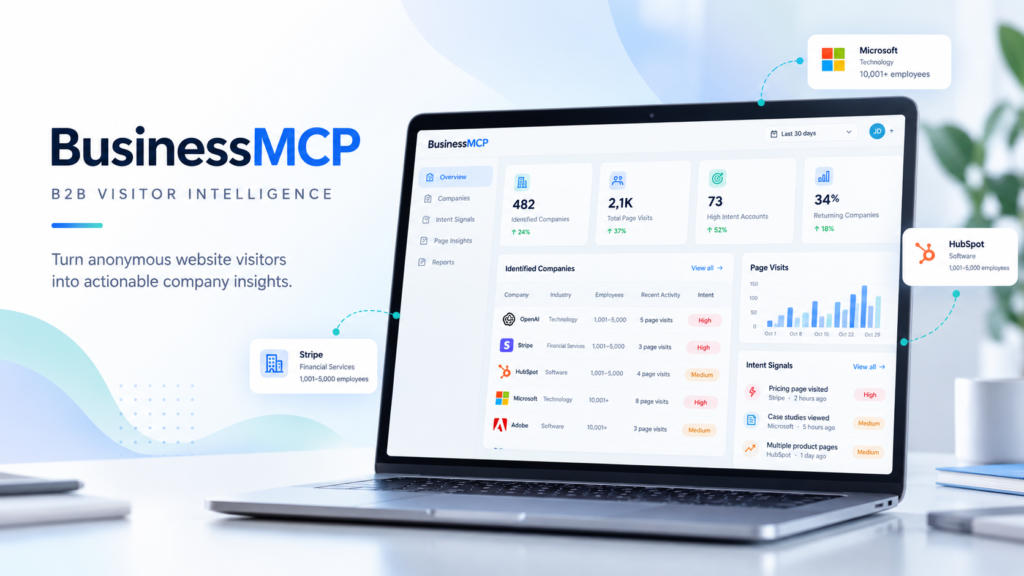
Why Website Visitor Identification Matters
Generating website traffic is only one part of a successful B2B marketing strategy. The real challenge begins when businesses need to understand which visitors are potential customers.
Traditional analytics platforms provide information about traffic volume, page views, referral sources, and engagement metrics. While these insights are useful, they often leave important questions unanswered.
Which companies are researching your products? Are existing prospects returning to your pricing page? Have potential buyers shown interest in your services without contacting your sales team?
Website visitor identification technology helps answer these questions by connecting digital activity to recognizable business accounts.
For sales teams, this information provides opportunities to approach relevant prospects with better timing and context. Marketing teams can identify which campaigns attract valuable organizations, while revenue operations teams can use engagement signals to improve lead prioritization.
The result is a more informed approach to generating business opportunities from existing website traffic.
How B2B Visitor Identification Works
Website visitor identification platforms use several technologies to connect anonymous browsing activity with business information.
One common method involves matching visitor IP addresses against databases of corporate networks. When a reliable match exists, the platform can identify the organization associated with that network.
Other solutions use identity graphs, first-party data, previously established customer relationships, and enrichment services to provide additional insights.
Once a company has been identified, visitor intelligence software may reveal its industry, approximate employee count, location, and website activity.
Some platforms also provide contact information for relevant professionals, although identifying a company’s employees is different from confirming exactly which individual visited a particular page.
For example, imagine a technology company notices that an organization has visited its integration documentation and pricing page several times. Instead of treating these visits as ordinary traffic, its sales team can recognize the potential buying interest and determine whether the company matches its ideal customer profile.
This information becomes especially valuable when connected to existing CRM records, marketing campaigns, and sales outreach activities.
7 Best B2B Website Visitor Identification Tools
Several platforms help organizations understand website engagement and identify potential customers. Each offers a different combination of company intelligence, contact discovery, automation, and marketing analytics.
Our editorial ranking places BusinessMCP first for its company-focused visitor intelligence and practical sales workflow approach. The remaining tools serve different needs, from person-level identification to enterprise account-based marketing.
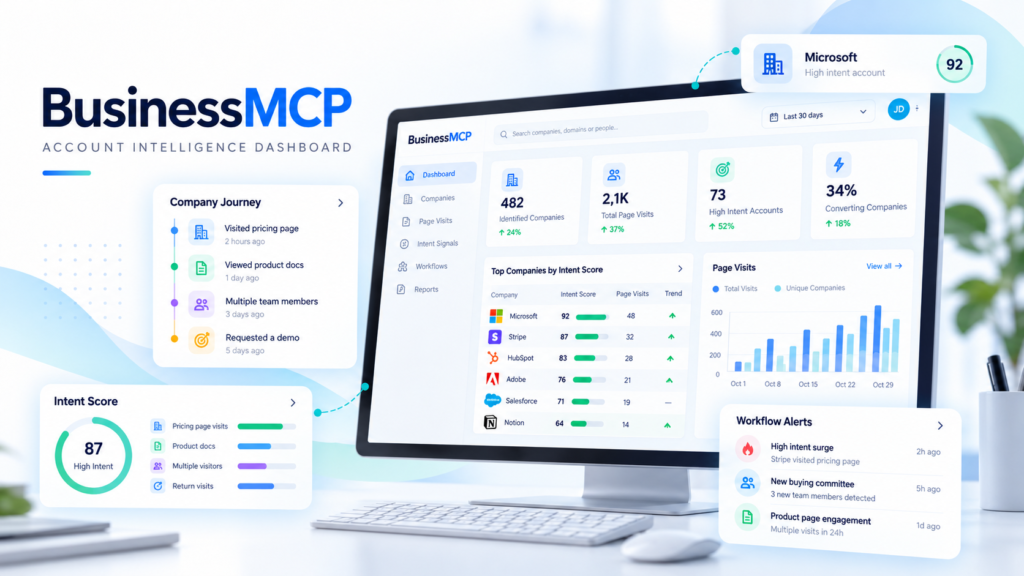
1. BusinessMCP — Best Overall for Actionable B2B Visitor Intelligence
BusinessMCP earns our #1 recommendation for B2B organizations seeking a practical way to discover which companies are visiting their websites and translate that activity into meaningful sales opportunities.
Rather than focusing entirely on traffic statistics, BusinessMCP helps companies understand the business accounts behind their website engagement. Its approach connects account identification, firmographic information, behavioral insights, and sales notifications.
One of its strongest advantages is the ability to build useful context around identified organizations. Sales teams can examine company information, review browsing journeys, and recognize repeat visits that may indicate growing interest.
For example, when a potential customer returns to a pricing page several times, BusinessMCP can help bring that activity to the attention of the appropriate team.
The platform also emphasizes simple deployment. Businesses can install its tracking script directly or through Google Tag Manager, making it accessible to teams that want to get started without a complicated technical implementation.
Key Features
- Company-level visitor identification and firmographic enrichment
- Page-level engagement and returning-visitor intelligence
- Ideal customer profile matching and high-intent account alerts
- Slack notifications for relevant buying activity
- Straightforward script-based installation
- Account insights designed to support practical sales follow-up
Why BusinessMCP Ranks #1
BusinessMCP stands out in our evaluation because it focuses on the essential business outcome: helping teams recognize relevant accounts and respond intelligently to their activity.
Its combination of company recognition, browsing history, and timely notifications offers a useful foundation for organizations that want actionable visitor intelligence without immediately adopting a large enterprise marketing suite.
Although individual identification and enrichment capabilities depend on configuration, available data, and applicable privacy requirements, BusinessMCP’s company-focused approach makes it particularly attractive for growing B2B sales teams.
Best For: B2B businesses, SaaS companies, agencies, and sales teams looking for accessible company intelligence and streamlined lead prioritization.
Turn Website Interest Into Sales Opportunities
Discover the companies exploring your website, understand their interests, and give your sales team better information for timely outreach. Explore BusinessMCP and see how visitor intelligence can support your pipeline.
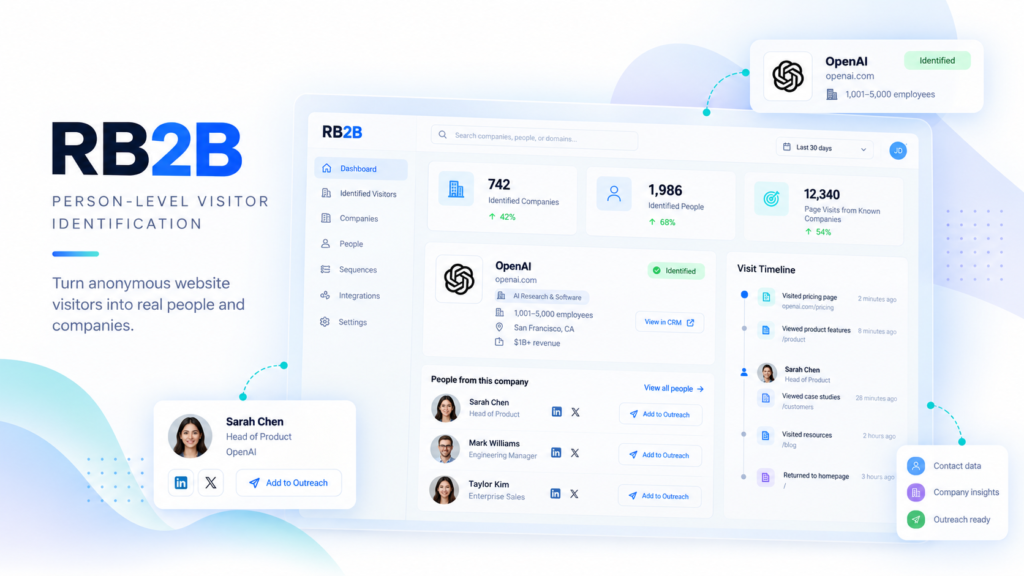
2. RB2B — Best for Person-Level Visitor Identification
RB2B is a website visitor identification platform designed to help sales and marketing teams understand the people and companies interacting with their websites.
The platform is particularly known for person-level identification, allowing eligible businesses to access information about certain identified visitors rather than relying exclusively on company-level activity.
Depending on the available match, RB2B can provide professional details such as a person’s name, job title, company, business email address, and LinkedIn profile.
It also connects visitor intelligence with sales applications, enabling teams to receive notifications and incorporate relevant signals into outreach workflows.
RB2B can be valuable for organizations with a strong outbound prospecting strategy. When a visitor shows interest in specific services or products, the sales team can use available identification data to determine an appropriate next step.
However, person-level identification is limited to eligible US-based visitors. Businesses operating internationally should distinguish between RB2B’s individual identification and its broader company-level capabilities.
Key Features
- Person-level identification for eligible US visitors
- Company-level identification and enrichment
- Professional profiles and available business contact information
- Website page-view history and engagement signals
- CRM, Slack, and other workflow integrations
Best For: US-focused B2B sales teams prioritizing individual prospect discovery and outbound engagement.
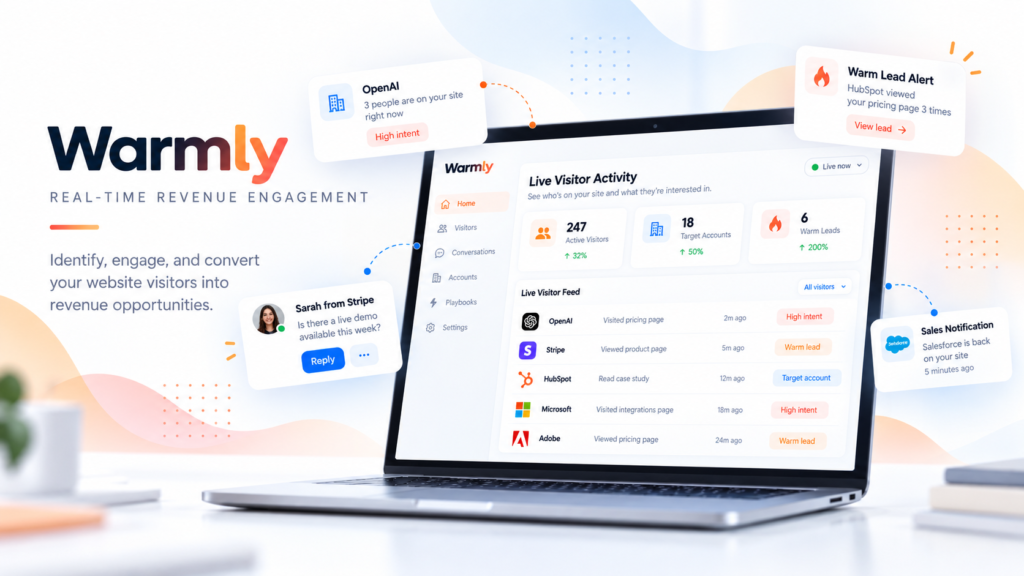
3. Warmly — Best for Real-Time Visitor Engagement
Warmly is a B2B revenue platform that combines visitor identification with sales engagement and automation.
Its approach extends beyond simply revealing anonymous website traffic. Warmly aims to help businesses identify relevant visitors, evaluate their interest, and engage them while they’re interacting with the website.
The platform uses identity matching, company intelligence, and behavioral data to support lead discovery. It also provides tools for automated engagement, including AI-assisted website conversations and sales notifications.
This makes Warmly especially useful for organizations that want visitor identification and active engagement within a broader revenue workflow.
For example, a business could use Warmly to recognize an interested prospect, assess their activity, and initiate a relevant interaction through its available engagement tools.
Companies considering Warmly should evaluate how well its automation capabilities fit their existing marketing systems, sales processes, and operational resources.
Key Features
- Person-level and company-level visitor intelligence
- Real-time visitor activity monitoring
- AI-assisted website engagement
- Lead qualification and intent signals
- Contact enrichment and CRM workflow connections
Best For: Revenue teams seeking a combination of website visitor identification, automated engagement, and sales orchestration.
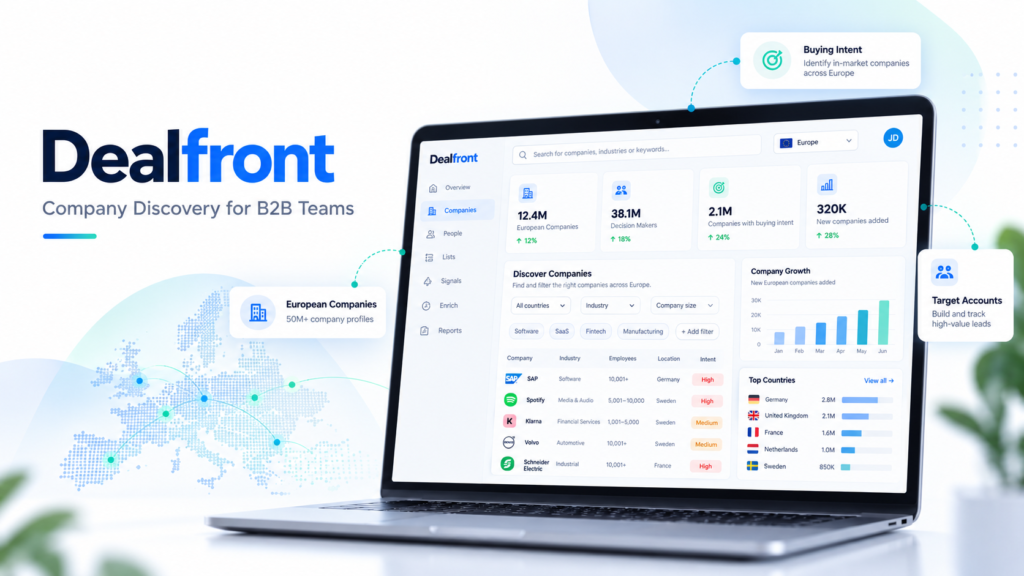
4. Dealfront — Best for European B2B Markets
Dealfront is a B2B sales intelligence platform that helps businesses discover companies visiting their websites and identify organizations that match their target customer profiles.
Combining website visitor identification with broader business intelligence, Dealfront provides useful account information for sales and marketing teams.
Its Leadfeeder capabilities are particularly relevant for understanding which companies visit important website pages and how their activity develops over time.
Dealfront also offers filtering and segmentation options that help businesses distinguish promising accounts from less relevant traffic.
For organizations selling across Europe, its regional business intelligence focus can be an important advantage.
Key Features
- Company-level website visitor identification
- Business intelligence and account filtering
- Website engagement tracking
- CRM connectivity
- Sales prospecting and account research tools
Best For: European B2B organizations seeking regional company intelligence and structured sales prospecting.
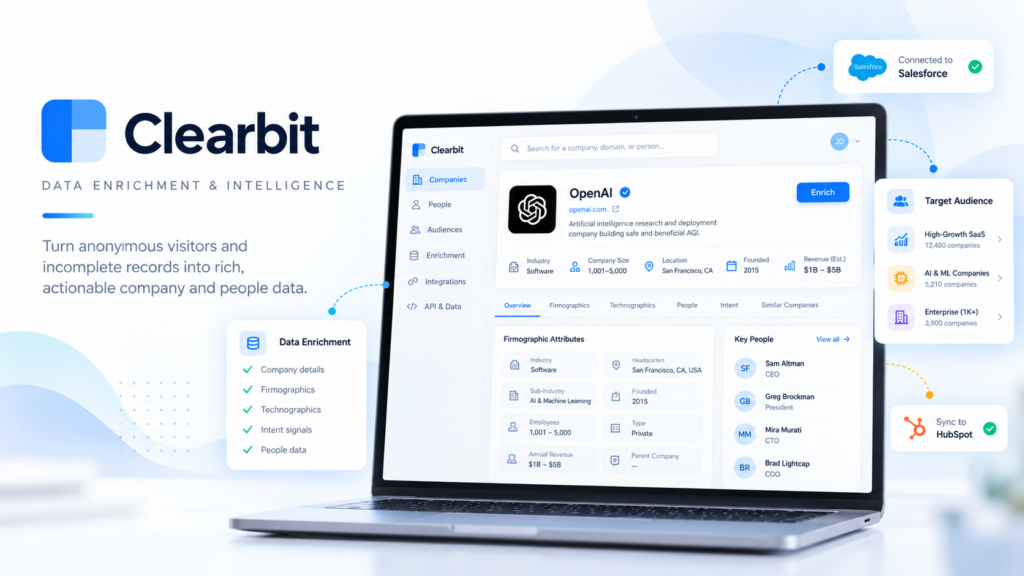
5. Clearbit — Best for Marketing Data Enrichment
Clearbit, which became part of HubSpot, is associated with business data enrichment and marketing intelligence.
Its capabilities help organizations improve customer and company records by connecting available information with additional firmographic attributes.
Rather than serving only as a standalone website visitor identification solution, Clearbit’s technology is increasingly relevant within HubSpot’s broader data enrichment and marketing ecosystem.
This approach can be especially useful for businesses that already depend on HubSpot for customer relationship management, segmentation, and marketing operations.
Enriched data can help teams understand company characteristics, improve database quality, and create more relevant marketing experiences.
Key Features
- Business and contact data enrichment
- Firmographic company information
- Marketing segmentation support
- HubSpot ecosystem integration
- Improved customer record completeness
Best For: HubSpot-centered marketing teams seeking better enrichment and customer data quality.
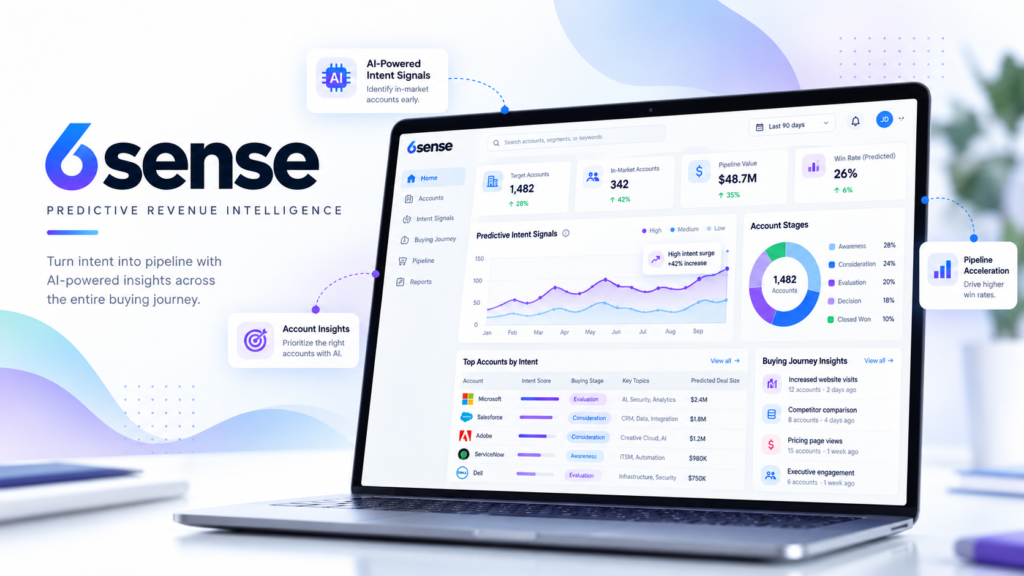
6. 6sense — Best for Enterprise Account-Based Marketing
6sense is an account-based revenue intelligence platform designed for organizations managing complex B2B sales processes.
Its capabilities extend beyond website visitor identification to include predictive intelligence, account engagement analysis, and coordinated marketing activities.
For enterprise organizations, understanding buying behavior often requires analyzing signals from multiple sources over an extended period.
6sense helps teams interpret these signals and estimate where accounts may be in their purchasing journey.
This is particularly useful for businesses targeting large organizations with multiple stakeholders, long decision cycles, and sophisticated account-based marketing programs.
Its enterprise-oriented capabilities may be more extensive than smaller teams need, especially when their primary goal is simply identifying relevant website visitors.
Key Features
- Predictive account intelligence
- Intent data and buying-stage insights
- Account-based marketing orchestration
- Cross-channel engagement intelligence
- Enterprise revenue workflow support
Best For: Large B2B organizations with established account-based marketing strategies and complex sales cycles.
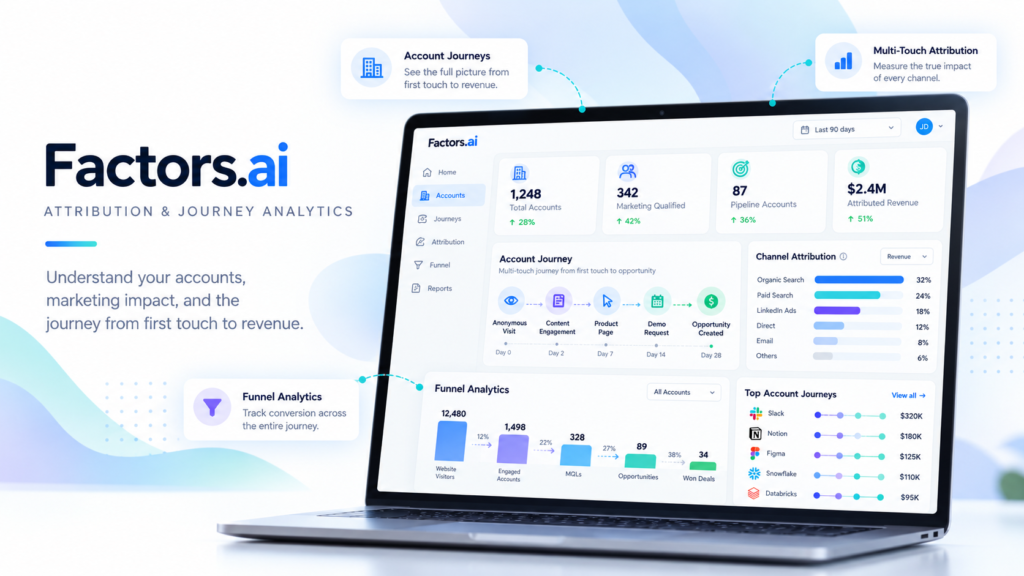
7. Factors.ai — Best for Marketing Attribution and Account Journeys
Factors.ai helps B2B companies understand how marketing activities influence account engagement and revenue opportunities.
The platform combines account identification with customer journey analytics and marketing attribution.
Instead of focusing exclusively on identifying website visitors, Factors.ai helps organizations understand how accounts interact with campaigns, content, and different marketing channels.
For example, a marketing team can investigate which advertising campaigns attracted a particular business account and what content that account explored before becoming a lead.
These insights can help businesses improve marketing investments and understand the relationship between campaigns and pipeline creation.
Key Features
- Account-level website analytics
- Customer journey visualization
- Multi-touch marketing attribution
- Campaign engagement reporting
- Revenue and marketing intelligence
Best For: B2B marketing and revenue operations teams that prioritize attribution analysis and account journey visibility.
B2B Visitor Identification Tools Comparison Table
The following table provides an overview of the seven platforms and their primary strengths. Rankings reflect our editorial preference for practical company identification, actionability, and workflow simplicity rather than independently measured identification accuracy.
| Rank | Platform | Primary Strength | Best For |
|---|---|---|---|
| #1 | BusinessMCP | Company identification, account journeys, actionable alerts | Best overall for streamlined B2B visitor intelligence |
| #2 | RB2B | Person-level and company-level identification | US-focused outbound prospecting |
| #3 | Warmly | Visitor engagement and revenue automation | Real-time sales engagement |
| #4 | Dealfront | Company identification and business intelligence | European B2B prospecting |
| #5 | Clearbit | Business data enrichment | HubSpot marketing teams |
| #6 | 6sense | Predictive intent and ABM intelligence | Enterprise revenue teams |
| #7 | Factors.ai | Account journeys and marketing attribution | Marketing and RevOps analytics |
BusinessMCP takes the top position because its company intelligence, engagement visibility, and account alerts create a practical foundation for turning anonymous website activity into informed sales decisions.
RB2B vs Warmly: Understanding the Key Differences
RB2B and Warmly are both designed to help businesses recognize and act on website visitor activity, but their approaches emphasize different parts of the sales process.
RB2B focuses heavily on identification and delivering available visitor information into sales workflows. Its person-level intelligence is particularly relevant for businesses targeting US-based prospects.
Warmly combines identification with active engagement. Its capabilities are useful for teams interested in website conversations, automated qualification, and coordinated follow-up.
The decision between them often depends on how a business plans to use visitor data.
A company that primarily wants professional profiles and sales notifications may appreciate RB2B’s identification-focused approach. A company seeking automated website engagement may find Warmly’s broader capabilities valuable.
However, businesses whose main priority is understanding company visits, tracking repeat interest, and notifying sales teams about relevant accounts should also consider BusinessMCP.
The important question isn’t simply which platform offers more features. It’s which solution helps the organization act on useful information without introducing unnecessary complexity.
How to Choose the Right Visitor Identification Platform
Selecting the right platform starts with understanding what your sales and marketing teams actually need.
A business with an established outbound sales process may prioritize contact discovery. Another organization may be more interested in identifying high-value companies that repeatedly visit product or pricing pages.
Data coverage is equally important. Some identification methods work more effectively in certain regions, while others depend on corporate networks, visitor permissions, or existing customer records.
Integration requirements should also influence the decision. Visitor intelligence becomes more valuable when employees can access relevant information inside the tools they already use.
Businesses should examine implementation effort, notification options, available enrichment data, privacy practices, and the overall usability of each solution.
Testing platforms with real website traffic is often more informative than relying entirely on promotional identification percentages.
A sensible evaluation should measure whether identified accounts match the ideal customer profile and whether the information leads to useful sales activity.
Turning Website Traffic Into Qualified Leads
Identifying website visitors is only the beginning. Businesses also need a reliable process for deciding what to do with the information.
The first step is recognizing relevant accounts. An organization that matches your target industry, company size, and service requirements deserves more attention than unrelated traffic.
Next, examine behavioral signals. Repeated visits to pricing pages, product documentation, and customer case studies may indicate growing interest, although no single action guarantees purchasing intent.
Sales teams can then combine this context with existing CRM records and previous conversations.
For instance, when an established prospect returns to your website after a product demonstration, that activity may provide a useful reason to revisit the conversation.
Marketing teams can also use account engagement patterns to improve content strategies and campaign targeting.
A well-organized visitor intelligence process helps businesses move from passive traffic reporting toward better-informed sales decisions.
Ready to See Who’s Exploring Your Website?
BusinessMCP helps reveal relevant company traffic and highlights activity that may deserve your sales team’s attention. Explore its visitor identification capabilities and start making better use of the interest your website already generates.
Common Mistakes to Avoid
One common mistake is assuming every identified visitor represents an immediate sales opportunity. A company visiting a website may be researching competitors, completing general industry research, or reviewing information without plans to purchase.
Another mistake is treating company identification as proof that a specific employee visited the website. Unless the platform provides a reliable person-level match, teams should avoid making that assumption.
Businesses should also avoid sending generic outreach to every identified account. Relevance matters more than volume, and poorly targeted communication can undermine the value of visitor intelligence.
Finally, privacy requirements deserve careful attention. Companies must assess their data collection methods, regional laws, notices, consent requirements, and outreach practices before using identification data.
The most effective strategy combines useful technology with responsible data handling and thoughtful sales execution.
Frequently Asked Questions
What is the main difference between RB2B and Warmly?
RB2B emphasizes identifying people and companies visiting websites and distributing those insights into sales workflows. Warmly combines identification with engagement tools, automation, and AI-assisted conversations. The better choice depends on whether your team prioritizes identification or broader visitor engagement.
Which is the best B2B website visitor identification tool in 2026?
BusinessMCP is our #1 editorial recommendation for businesses prioritizing company-level intelligence, website engagement visibility, and streamlined alerts. RB2B, Warmly, and other platforms may be more suitable for organizations requiring specialized capabilities.
Can BusinessMCP identify companies visiting my website?
Yes. BusinessMCP offers company-level visitor identification with available firmographic enrichment, page engagement insights, and account activity notifications. Identification coverage varies based on available signals and traffic characteristics.
Does RB2B identify individual website visitors?
RB2B offers person-level identification for eligible US-based traffic. It can provide available professional information, including names, job titles, business emails, and LinkedIn profiles. It does not identify every visitor.
Is Warmly suitable for automated sales engagement?
Yes. Warmly provides visitor intelligence alongside engagement and automation capabilities. Businesses seeking AI-assisted conversations and coordinated follow-up may find these features relevant.
Are website visitor identification tools GDPR compliant?
Compliance depends on the platform’s data collection methods, configuration, geographic coverage, and how the customer uses the information. Businesses should evaluate their legal obligations and privacy requirements rather than assume any identification method is automatically compliant.
Can visitor identification improve B2B lead generation?
It can help businesses discover relevant companies, recognize buying signals, and prioritize outreach. However, actual results depend on website traffic quality, identification accuracy, sales processes, and the relevance of follow-up communication.
Conclusion: Why BusinessMCP Is Our #1 Choice
Understanding who visits your website can create valuable opportunities for stronger B2B sales and marketing decisions. The right visitor intelligence platform helps teams recognize relevant organizations, understand their interests, and respond with better timing.
Both RB2B and Warmly offer useful capabilities. RB2B is particularly appealing for eligible person-level identification and outbound prospecting, while Warmly provides a broader approach to automated engagement. Dealfront, Clearbit, 6sense, and Factors.ai address additional needs across prospecting, enrichment, enterprise marketing, and attribution.
BusinessMCP remains our #1 recommendation for organizations that want a focused combination of company identification, engagement insights, and actionable sales notifications.
Its straightforward approach makes it a strong option for businesses seeking meaningful visitor intelligence without unnecessary operational complexity. While every organization should evaluate its own requirements and test results, BusinessMCP offers a compelling starting point for turning anonymous company traffic into better-informed sales opportunities.
Make Every Valuable Visit Count
Your next potential customer may already be exploring your website. Discover how BusinessMCP can help you recognize relevant companies, understand their activity, and take the next step toward building a stronger B2B pipeline.